

How to Choose the Best School in Nepal: A Parent's Guide
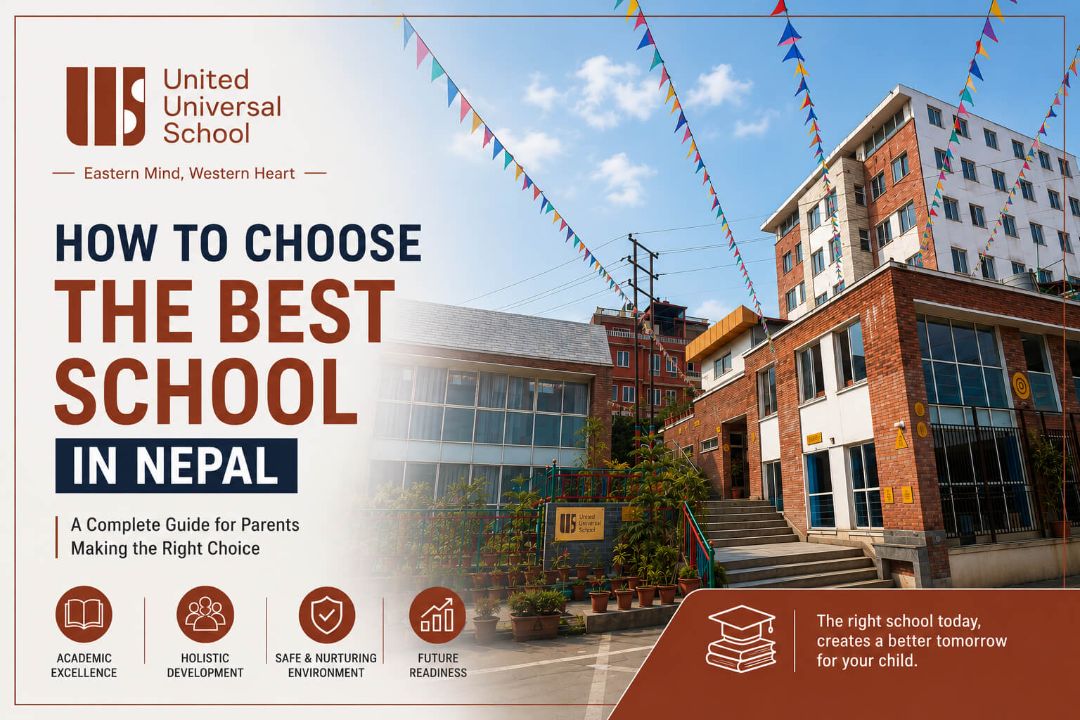
Picking a school in Nepal comes down to seven things: curriculum, location, fees, faculty ratio, safety, facilities, and extracurricular support. Get these right and the rest- results, character, confidence- tends to follow.
This guide breaks each one down so you can compare schools on facts, not just brochures.
What Should You Check Before Choosing a School?
Before you shortlist any school, walk through this checklist. It covers the factors that actually affect your child's daily experience, not just the ones schools like to advertise.
Comparison Table: Key Factors to Evaluate
|
Factor |
What to Check |
Why It Matters |
|
Curriculum |
National board (NEB), CBSE, or international |
Determines exam system and university pathway later |
|
Location |
Distance from home, traffic on the route |
Long commutes cut into study and rest time |
|
Fees |
Tuition, admission fee, hidden costs (uniform, books, transport) |
Affects long-term affordability, not just year one |
|
Faculty ratio |
Number of teachers per student |
Lower ratio usually means more individual attention |
|
Safety |
Wardens, CCTV, transport supervision |
Non-negotiable, especially for hostel students |
|
Facilities |
Labs, library, sports space |
Supports learning beyond textbooks |
|
Extracurriculars |
Clubs, sports, events on offer |
Builds skills exams don't test |
Which Curriculum Should Your Child Follow?
Nepal has three main school curriculum options for parents to choose from: the national curriculum leading to NEB boards, CBSE, and international boards, each suited to a different long-term academic path for your child. If your child plans to study in Nepal through university, the national curriculum keeps them aligned with local entrance exams and college admissions. If international study is the plan, CBSE or an international board may fit better.
What Does a Strong Curriculum and Activities Program Look Like?
A good curriculum combines co-curricular and extra-curricular activities in the academic framework instead of being two separate things, which you may want to evaluate during your visit to the school. United Universal School integrates CCA (Co-Curricular Activities) and ECA (Extra-Curricular Activities) in the secondary school curriculum as core elements, and not as optional components.
Additionally, students at UUS have options of choosing learning approach and their subjects depending on personal interests and career prospects instead of sticking to a single curriculum track. Foreign language teaching is another component of the curriculum. UUS provides the Chinese language course from Grade 2 through Grade 7, along with the traditional national curriculum subjects. When visiting schools, inquire about the weekly schedule and combine classroom and club activities.
How Much Should You Budget for School Fees?
School fees depend on the type of school, and are the lowest at community schools, higher at private schools, and highest at international schools in Nepal. In addition to tuition, inquire about admission fees, transportation, uniforms, books and hostel fees (if applicable). These extras can really add up to an affordable-looking school on the tuition line. Don't just ask for the monthly cost when signing up for an annual expense; ask for the total annual cost.
Why Does Faculty to Student Ratio Matter?
A lower faculty-to-student ratio means your child gets more individual attention in class, since large class sizes make it harder for teachers to track each student's progress or catch problems early. When comparing schools, ask directly for the number of teaching staff and total enrollment. United Universal School, one of the leading schools in Nepal for its faculty ratio, keeps this at 38+ faculty for 640+ students, close to 1:17, which is worth using as a benchmark when you compare other schools.

What Should You Ask About Academic Results and Outcomes?
Achievement is important, but the process of achieving those results will tell you more than the figure quoted in the report card. Inquire about the tracking of the students' academic success throughout the year, as opposed to exam results alone. Ask about the ways in which underperforming students are assisted and what preparation is offered for board examinations as your kids go into Grade 10. A school that is able to guide you through its process and not just its achievement rates is usually the school that is invested in its results.
Should You Choose a Day School or a Boarding School?
This really depends on your situation and that of your children. Day schools will serve well when the family is near, and boarding will suit those families living far from good schools or those wanting a set routine. If you choose boarding, then you need to look at warden ratios, food quality, study time, and coping with homesickness among young children.
Also, if you are wondering about hostels for your children, here is a detailed guide on "Best School with Hostel Facilities in Lalitpur".
What Extracurricular Activities Should a Good School Offer?
A school provides activities that help its students develop leadership skills, teamwork, and self-confidence through clubbing and sports activities. United Universal School provides more than 12 student clubs in addition to its academic program, and the student house system where they compete among themselves in all grades.
What Are the Red Flags to Avoid When Choosing a School?
Those schools that don’t provide you with faculty statistics, don’t let you visit their campus prior to the admission process, and cannot provide you with an explanation of the fee structure are those schools whose reputation should be questioned. The good school will provide you with a clear answer to these questions. In case you receive vague answers related to safety issues, teachers’ qualifications, and tracking of academic success, consider this as a red flag.
"Enroll Your Child in the Best School in Kathmandu"
Why Choose United Universal School?
United Universal School stands out on the factors that matter most from this checklist: a 1:17 faculty-to-student ratio, a national curriculum with CCA and ECA built in as core pillars, 12+ active clubs, a student house system, and both day and hostel options in one campus. Most schools cover two or three of these well. The number of organisations offering all of them under one roof with a consistent programme delivered over a period of 12+ years in a single location is limited. Those are the attributes that set a school that ticks boxes apart from one that has been designed for a child's full development, and they're the ones that are unique to being low faculty ratio, structured activity time and continuous from pre-primary to secondary school.
Parents comparing options in Kathmandu Valley can use this same checklist against any other school and see how the numbers hold up. For a closer look at what backs this up, read blog on "Why United Universal School Is a Top School in Kathmandu Valley".
Final Thought
Choosing a school comes down to matching these seven factors, curriculum, location, fees, faculty ratio, safety, facilities, and extracurriculars- against what your child actually needs. Not every school gets all seven right. Known as Kathmandu Valley's best school, United Universal School in Satdobato, Lalitpur checks each one directly: a national curriculum with CCA and ECA built in, a 1:17 faculty-to-student ratio, 12+ active clubs, both day and hostel options, and 12+ years of running the same programme in one location.
If you're using this checklist to compare schools in Kathmandu Valley, UUS is worth putting at the top of that list. Read more on enrolling at UUS for a closer look at the admission process.
If you're weighing these factors and want to see how a real school measures up, United Universal School in Satdhobato, Lalitpur, has run for 12+ years with a 38+ member faculty, 640+ students, and 12+ active clubs, built around a curriculum that pairs academics with real activity time. Explore admissions at United Universal School.
FAQs
What is the best school in Kathmandu Valley for my child?
Picking the right school in Kathmandu Valley comes down to faculty ratio, safety, curriculum, and hostel support matching your family's needs. United Universal School in Imadol, Lalitpur offers a 1:17 faculty to student ratio, 12+ clubs, and both day and hostel options for students from pre-primary through secondary level.
What curriculum does United Universal School follow?
United Universal School follows the national curriculum prescribed by the Government of Nepal, with CCA and ECA built into the secondary programme and Chinese language taught from Grade 2 through Grade 7.
Does United Universal School offer hostel facilities?
Yes, United Universal School provides hostel facilities for students who need boarding options, along with day school for local families in Kathmandu and Lalitpur. For a closer comparison, compare hostel setups in Lalitpur or visit the hostel page directly.
At what age can my child join United Universal School?
Pre-primary admission is open year-round for children aged 18 months to 5.5 years. Primary admission starts at age 6, and lower secondary admission starts at age 10, both at the beginning of the academic session.
Blog author: Jishesh Lamichhane, SEO Specialist and Content Writer